Qeltraviox
Vertex Series
Vertex Series
Couldn't load pickup availability
1. Problem Statement
Large Kotlin projects can become difficult to review when architectural decisions are made only after the code has already grown. Domain rules may be scattered across services, models, and coordination classes without a clear central structure. Concurrent tasks, state updates, and data conversions can create relationships that are hard to trace. Teams may also use different naming and component patterns, reducing consistency across separate project sections. Vertex Series addresses these challenges through a complete planning and implementation route built around defined responsibilities, documented decisions, and structured review.
2. Solution
Vertex Series guides learners through the design of a broad Kotlin system from initial requirements to final structural review. Each module combines architectural planning, Kotlin implementation, documentation, and practical inspection activities. Learners define domain boundaries, data routes, state transitions, dependencies, and concurrency rules before combining components. Scenario exercises invite learners to compare alternative structures and explain the reasoning behind each choice. The closing project connects all course topics within one documented multi-module system.
3. What’s Inside
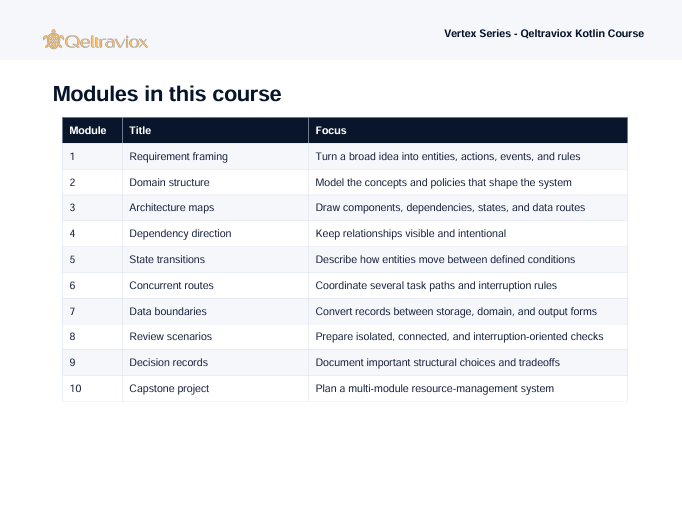
The opening module focuses on requirement analysis. Learners turn broad project ideas into entities, rules, actions, events, data needs, and component responsibilities. A planning worksheet helps separate core requirements from optional features.
The architecture-mapping section introduces component diagrams, dependency routes, state maps, and data-flow documentation. Learners define which sections may communicate directly and which relationships should be managed through contracts.
A domain-rules module explores policies that coordinate several entities and values. Learners create focused Kotlin components for rules that do not naturally belong inside one model.
Vertex Series includes an expanded concurrency section covering task coordination, structured cancellation, shared-state review, operation grouping, and defined failure responses. Learners examine how several asynchronous routes can work together without hiding important state changes.
The data-boundary module covers mapping between storage-focused records, domain structures, processing models, and output formats. Learners create dedicated conversion components and document each change in the data route.
A component-verification section examines isolated checks, integration scenarios, state-transition checks, and concurrency-related cases. Learners prepare test data, expected outcomes, unusual inputs, and interruption scenarios.
The maintainability module focuses on naming, documentation, dependency direction, module size, and repeated architectural patterns. Learners use a structured review sheet to identify mixed responsibilities and unnecessary relationships.
A decision-record section introduces concise architectural notes. Learners document the issue, available choices, selected direction, reasoning, and later review points for important structural decisions.
The closing project involves creating a multi-module resource-management system. Learners define requirements, domain models, state transitions, asynchronous operations, data conversions, component contracts, verification scenarios, and architectural records.
4. Who Is This For?
Vertex Series is intended for learners with broad Kotlin knowledge who want to bring language features, architecture methods, and project-review practices into one connected course.
It may suit:
- Learners planning broad Kotlin systems
- Students reviewing architectural decisions
- Learners coordinating several project modules
- People working with domain rules and state transitions
- Students examining concurrency and data boundaries
- Learners developing documentation and review habits
- People completing the Qeltraviox course collection
5. What You’ll Learn
- Convert requirements into structured project plans
- Define entities, actions, rules, and events
- Create architecture and dependency maps
- Organize domain policies
- Coordinate asynchronous operations
- Review shared-state changes
- Define cancellation and failure routes
- Build clear data-conversion boundaries
- Prepare isolated and connected component checks
- Review unusual inputs and interruption cases
- Document important architectural decisions
- Apply consistent naming across modules
- Identify mixed component responsibilities
- Review dependency direction
- Build a documented multi-module Kotlin project
6. 30-Day Refund Policy
Refund requests for Vertex Series may be submitted within 30 days of purchase. Each request is reviewed according to the store policy, purchase information, and the circumstances described by the learner.
Self-paced learning overview
- 📥 Digital file available after purchase
- 🗂️ Long-term availability
- 🔒 Secure checkout
- 📅 Content updated in 2026
Are Qeltraviox courses suitable for new learners?
Are Qeltraviox courses suitable for new learners?
Yes. The course collection begins with introductory materials and gradually moves toward broader Kotlin topics. Each tier follows a structured learning route with explanations, examples, exercises, and review activities.
Can I study at my own pace?
Can I study at my own pace?
Yes. Learners can review the materials according to their personal schedule. Lessons can be revisited whenever additional practice or clarification is needed.
How are the course materials organized?
How are the course materials organized?
The materials are divided into lessons, modules, practical tasks, reference notes, and short review sections. Topics are arranged in a logical order so learners can study one concept before moving to the following subject.
Share