Qeltraviox
Shift Series
Shift Series
Couldn't load pickup availability
1. Problem Statement
Broader Kotlin projects often contain many components that depend on one another in unclear ways. Concurrent tasks may update the same information, creating behavior that is difficult to trace. Data can pass through several transformations without a visible route or defined responsibility. Verification activities may be added only after the structure is complete, making isolated review harder. Shift Series addresses these challenges through structured lessons on concurrent work, modular separation, predictable data movement, and component-focused checks.
2. Solution
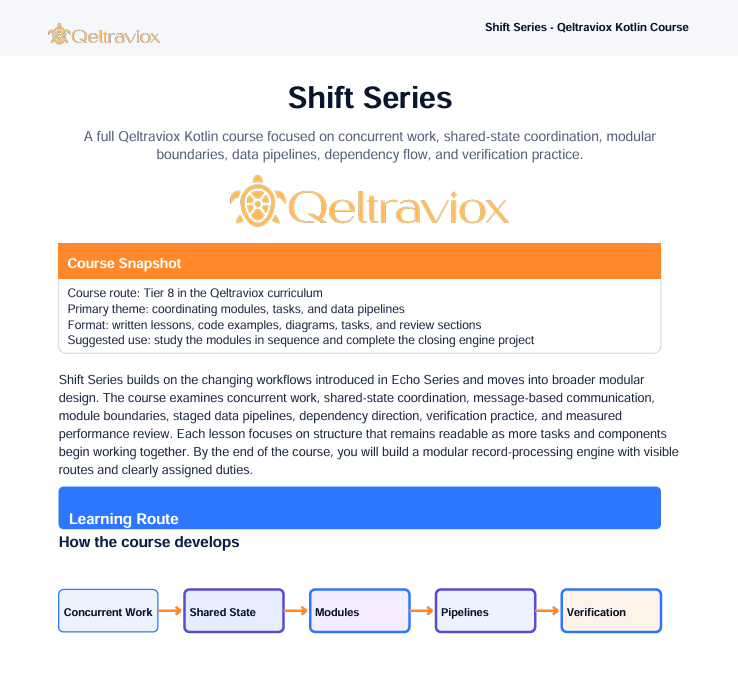
Shift Series presents Kotlin architecture as a collection of connected but clearly divided modules. Learners study how concurrent tasks can be coordinated, how shared information can be managed, and how dependencies can remain visible. Each lesson combines written explanations, annotated examples, structural diagrams, and guided reconstruction activities. Learners review each component in isolation before connecting it to the wider project. The final activity brings the course topics together in a modular processing system with documented routes and defined responsibilities.
3. What’s Inside
The opening module examines concurrency and shared information. Learners compare independent tasks, coordinated tasks, and situations where several operations interact with the same state. Activities include tracing updates and identifying places where unclear timing may affect the project.
A synchronization section introduces structured methods for coordinating shared values. Learners review protected updates, controlled state changes, and message-based communication between components. The examples focus on keeping shared information consistent and understandable.
The modular-boundaries module explores how a broad project can be divided into focused sections. Learners define responsibilities for data models, processing rules, storage components, coordinators, and output preparation. They also review which dependencies should remain inside a module and which relationships should be visible outside it.
Shift Series includes a detailed data-pipeline section. Learners design routes where information is collected, validated, converted, grouped, and prepared for later use. Each stage receives a defined input and returns a documented outcome.
The dependency-flow module examines how components receive supporting tools and services. Learners create constructor-based relationships, interface contracts, and small configuration structures. Exercises focus on replacing hidden component creation with visible dependency passing.
A verification-practices section covers isolated checks, integration checks, and scenario-based review. Learners prepare sample inputs, expected outcomes, edge cases, and failure states for functions and components. The course also explains how test doubles can represent supporting dependencies during focused review activities.
The performance-awareness module introduces measured code inspection. Learners examine repeated collection operations, unnecessary object creation, and broad processing loops. The aim is to identify avoidable work while retaining readable code.
The closing project involves building a modular record-processing engine. Learners coordinate concurrent tasks, protect shared state, create data pipelines, pass dependencies, and prepare a documented verification plan.
4. Who Is This For?
Shift Series is intended for learners who understand asynchronous operations, observable state, interfaces, layered structures, and component coordination.
It may suit:
- Learners studying concurrent Kotlin tasks
- Students organizing modular project sections
- Learners building structured data pipelines
- People reviewing dependency relationships
- Students developing component-focused checks
- Learners preparing for broader Qeltraviox architecture topics
5. What You’ll Learn
- Coordinate concurrent Kotlin tasks
- Review shared-state interactions
- Apply structured synchronization methods
- Divide a project into focused modules
- Define clear module boundaries
- Build staged data-processing routes
- Validate and convert information between stages
- Pass dependencies through visible structures
- Create interface-based component relationships
- Prepare isolated component checks
- Review integration scenarios
- Define edge cases and failure states
- Identify repeated processing work
- Document data and dependency routes
- Build a modular Kotlin practice project
6. 30-Day Refund Policy
Refund requests for Shift Series may be submitted within 30 days of purchase. Each request is reviewed according to the store policy, purchase information, and the details shared by the learner.
Self-paced learning overview
- 📥 Digital file available after purchase
- 🗂️ Long-term availability
- 🔒 Secure checkout
- 📅 Content updated in 2026
Are Qeltraviox courses suitable for new learners?
Are Qeltraviox courses suitable for new learners?
Yes. The course collection begins with introductory materials and gradually moves toward broader Kotlin topics. Each tier follows a structured learning route with explanations, examples, exercises, and review activities.
Can I study at my own pace?
Can I study at my own pace?
Yes. Learners can review the materials according to their personal schedule. Lessons can be revisited whenever additional practice or clarification is needed.
How are the course materials organized?
How are the course materials organized?
The materials are divided into lessons, modules, practical tasks, reference notes, and short review sections. Topics are arranged in a logical order so learners can study one concept before moving to the following subject.
Share