Qeltraviox
Quantum Series
Quantum Series
Couldn't load pickup availability
1. Problem Statement
As Kotlin projects expand, learners may struggle to keep business rules, data models, state updates, and supporting logic clearly separated. Broad components can begin to depend on internal details that should remain hidden from other parts of the project. Similar rules may be repeated in several locations, leading to inconsistent behavior and difficult maintenance. Data may also move between layers without clear conversion points or documented boundaries. Quantum Series addresses these challenges by presenting structured methods for modeling domains, protecting component boundaries, and coordinating system-wide behavior.
2. Solution
Quantum Series guides learners through a layered approach to broad Kotlin project design. Each module examines one architectural concern and connects it to a practical coding activity. Learners create domain models, define component contracts, organize state transitions, and document information routes before implementation. Guided restructuring tasks show how closely connected code can be divided into focused sections. The closing project combines these practices in a multi-module Kotlin system with clearly described responsibilities.
3. What’s Inside
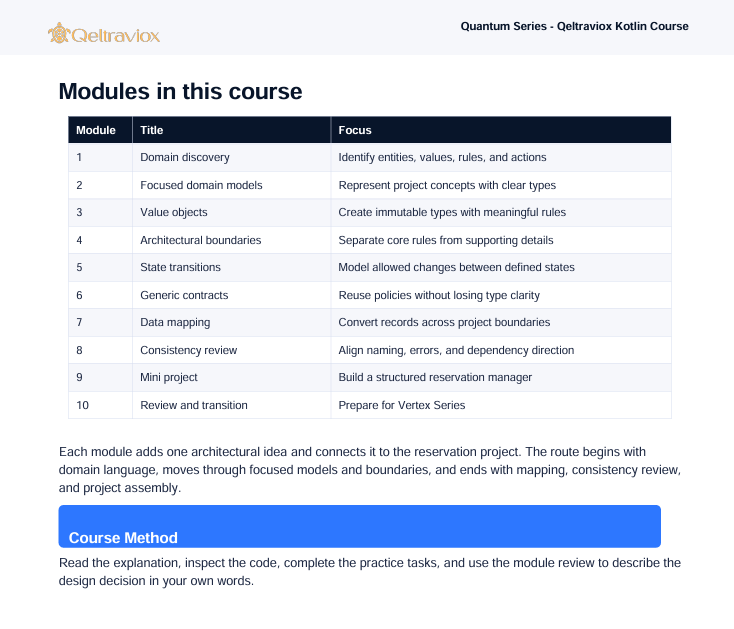
The opening module introduces domain-centered modeling. Learners identify important entities, values, rules, and actions within a project scenario. They then create Kotlin classes that represent these concepts without mixing storage, formatting, or presentation duties into the core model.
A value-object section explores small types that represent meaningful information such as identifiers, categories, ranges, and statuses. Learners use validation rules and immutable values to keep domain information consistent across the project.
The architectural-boundaries module examines how internal rules can remain separate from external data sources and presentation concerns. Learners define interfaces between sections and review which details should remain private within each component.
Quantum Series also includes a state-transition module. Learners represent how an entity moves from one defined state to another and document which actions are allowed at each stage. Exercises include building transition tables and translating them into readable Kotlin logic.
The abstraction section covers generic contracts, reusable policies, and type-safe wrappers. Learners create shared structures for validation, processing, and result handling while retaining meaningful naming and clear behavior.
A data-mapping module explores conversion between external records, internal domain models, and presentation-focused structures. Learners build dedicated mapping components and review where each conversion should occur.
The consistency section examines shared naming rules, error states, dependency direction, and module documentation. Learners create a project-wide checklist that supports readable structure across separate sections.
A scenario-review module presents several architectural choices for the same project. Learners compare the tradeoffs, identify unnecessary complexity, and select a structure based on the project’s actual needs.
The final project involves building a structured reservation manager. Learners define domain models, value objects, state transitions, component contracts, mapping rules, and coordination services before assembling the complete Kotlin workflow.
4. Who Is This For?
Quantum Series is intended for learners who already understand modular structure, asynchronous workflows, interfaces, data pipelines, and dependency organization.
It may suit:
- Learners studying domain-focused Kotlin design
- Students working with broad project structures
- Learners organizing state transitions
- People creating reusable type-safe abstractions
- Students reviewing architectural boundaries
- Learners preparing for the final Qeltraviox tier
5. What You’ll Learn
- Identify entities, values, rules, and actions
- Create focused domain models
- Build immutable value objects
- Define validation rules for meaningful types
- Separate internal logic from supporting components
- Create clear interface boundaries
- Model structured state transitions
- Document allowed actions between states
- Build reusable generic contracts
- Create type-safe wrappers
- Convert information between project layers
- Organize dependency direction
- Review architectural tradeoffs
- Prepare project-wide structure guidelines
- Build a multi-module Kotlin practice project
6. 30-Day Refund Policy
Refund requests for Quantum Series may be submitted within 30 days of purchase. Each request is reviewed according to the store policy, the purchase information, and the details provided by the learner.
Self-paced learning overview
- 📥 Digital file available after purchase
- 🗂️ Long-term availability
- 🔒 Secure checkout
- 📅 Content updated in 2026
Are Qeltraviox courses suitable for new learners?
Are Qeltraviox courses suitable for new learners?
Yes. The course collection begins with introductory materials and gradually moves toward broader Kotlin topics. Each tier follows a structured learning route with explanations, examples, exercises, and review activities.
Can I study at my own pace?
Can I study at my own pace?
Yes. Learners can review the materials according to their personal schedule. Lessons can be revisited whenever additional practice or clarification is needed.
How are the course materials organized?
How are the course materials organized?
The materials are divided into lessons, modules, practical tasks, reference notes, and short review sections. Topics are arranged in a logical order so learners can study one concept before moving to the following subject.
Share