Qeltraviox
Neon Framework
Neon Framework
Couldn't load pickup availability
1. Problem Statement
Learners often reach a stage where individual Kotlin examples feel understandable, yet broader projects remain difficult to organize. Classes may contain too many responsibilities, functions may depend on unclear data, and collections may be processed through repeated code. Without a planned structure, even a small project can become difficult to read and adjust. Learners may also know how to write a feature but struggle to decide where each part should belong. Neon Framework addresses this gap by introducing practical methods for arranging related logic into focused components.
2. Solution
Neon Framework presents project organization through a sequence of connected Kotlin modules. Learners study how data models, functions, collections, and class relationships can support one another without becoming tightly mixed. Each lesson includes annotated examples, guided restructuring tasks, and short design reviews. The materials encourage learners to identify responsibilities before writing code and to review how information moves between components. By the end of the course, learners complete a structured project that combines the main topics in one consistent workflow.
3. What’s Inside
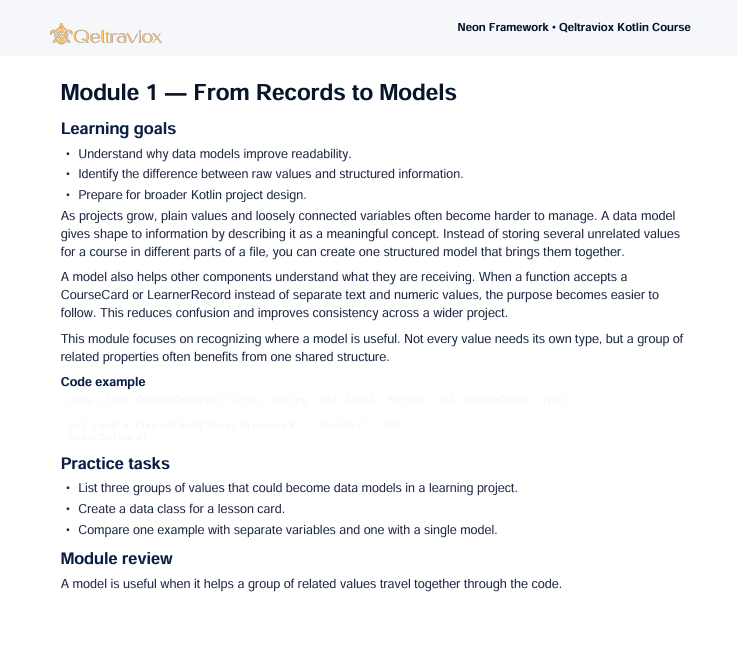
The opening module reviews classes, objects, properties, methods, and constructors from a project-structure perspective. Learners examine how a class can represent one clear concept and how unrelated responsibilities can be moved into separate components.
A detailed data-modeling section explores structured records, immutable values, and readable object creation. Learners build models for study records, inventories, schedules, and task collections. Exercises focus on selecting useful properties, assigning clear names, and keeping models focused.
The class relationships module introduces composition and inheritance through measured examples. Learners compare different ways of connecting classes and consider which structure keeps the code easier to understand. Activities include combining small components, extending shared behavior, and removing unnecessary dependencies.
The course then moves into collection processing. Learners work with mapping, filtering, grouping, sorting, and summarizing stored information. Each operation is explained through practical data examples, followed by exercises that combine several operations into one readable sequence.
A reusable logic module covers higher-order functions, function references, and lambda expressions. Learners study how behavior can be passed into another function and how repeated collection tasks can be shortened without reducing clarity.
The error-handling section introduces common runtime issues and structured responses to invalid data. Learners review input checks, result states, and exception handling through small scenarios.
Neon Framework also includes a project-planning worksheet. Learners define the purpose of each component, map relationships between classes, and list the functions needed before implementation begins.
The closing project centers on a structured information manager. Learners create models, connect components, process collections, validate values, and review the final code using a responsibility checklist.
4. Who Is This For?
Neon Framework is intended for learners who understand Kotlin foundations and want to develop stronger project-organization habits.
The course may suit:
- Learners familiar with functions, collections, and classes
- Students exploring broader code structures
- Learners studying data models and class relationships
- People interested in reusable collection logic
- Learners who want guided restructuring practice
- Students preparing for the following Qeltraviox tiers
5. What You’ll Learn
- Define focused Kotlin data models
- Separate responsibilities between classes
- Connect components through composition
- Compare composition and inheritance
- Process collections with mapping and filtering
- Group and sort structured data
- Write lambda expressions
- Use higher-order functions
- Reuse behavior across related tasks
- Validate incoming values
- Handle common runtime issues
- Plan component relationships before coding
- Review code for unnecessary dependencies
- Complete a structured Kotlin project
6. 30-Day Refund Policy
Refund requests for Neon Framework may be submitted within 30 days of purchase. Each request is reviewed according to the store policy, purchase details, and the information provided by the learner.
Self-paced learning overview
- 📥 Digital file available after purchase
- 🗂️ Long-term availability
- 🔒 Secure checkout
- 📅 Content updated in 2026
Are Qeltraviox courses suitable for new learners?
Are Qeltraviox courses suitable for new learners?
Yes. The course collection begins with introductory materials and gradually moves toward broader Kotlin topics. Each tier follows a structured learning route with explanations, examples, exercises, and review activities.
Can I study at my own pace?
Can I study at my own pace?
Yes. Learners can review the materials according to their personal schedule. Lessons can be revisited whenever additional practice or clarification is needed.
How are the course materials organized?
How are the course materials organized?
The materials are divided into lessons, modules, practical tasks, reference notes, and short review sections. Topics are arranged in a logical order so learners can study one concept before moving to the following subject.
Share