Qeltraviox
Drift Module
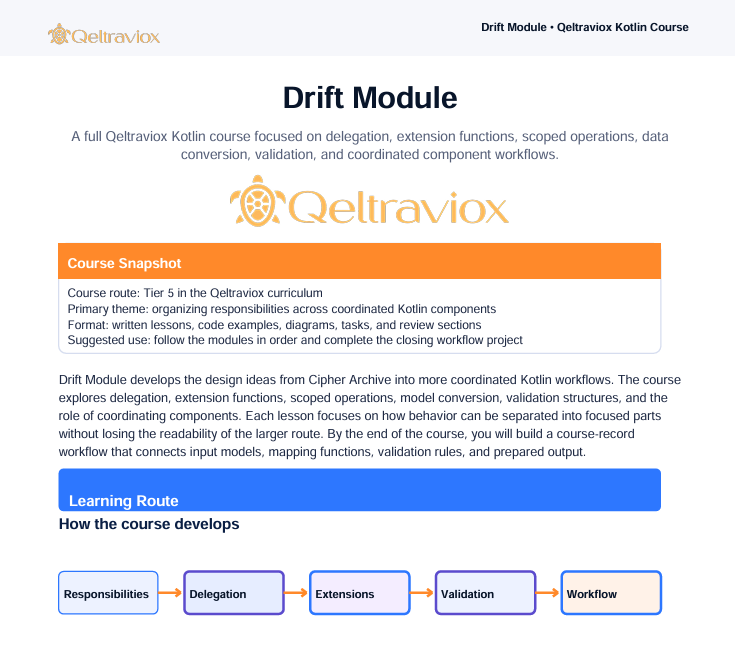
Drift Module
Couldn't load pickup availability
1. Problem Statement
Kotlin learners may understand classes, interfaces, and collections while still finding broader project structures difficult to maintain. Logic can become scattered across unrelated functions, and repeated operations may appear in several components. Some classes may handle data storage, validation, formatting, and processing at the same time. This makes the code harder to review and can hide the purpose of each section. Drift Module addresses these challenges by presenting clear methods for dividing responsibilities and coordinating related components.
2. Solution
Drift Module organizes each topic around a specific structural challenge and a practical Kotlin response. Learners study how delegation, extension functions, scoped operations, and focused components can reduce repetition and clarify intent. Guided exercises ask learners to compare several code structures before selecting a suitable arrangement. Refactoring activities show how broad classes can be divided into smaller sections with defined duties. The closing project connects these ideas through a structured data-processing workflow.
3. What’s Inside
The opening module reviews component responsibilities and dependency relationships. Learners examine sample classes, identify mixed duties, and create a written map showing how each component contributes to the wider project.
The delegation section introduces ways to assign selected behavior to supporting components. Learners study class delegation and delegated properties through practical examples involving settings, records, and state management. Each activity focuses on reducing repeated logic while keeping responsibilities visible.
A dedicated module explores extension functions and extension properties. Learners add focused operations to existing types without placing unrelated behavior inside the original class. Examples include text formatting, collection review, value checks, and model conversion.
The scoped operations section covers structured ways to configure objects, perform calculations, and work with nullable values. Learners compare several scoped forms and review when each one keeps the code readable. Exercises require learners to rewrite dense code blocks into clearer sequences.
Drift Module also includes a data-conversion section. Learners convert one model into another, separate internal records from presentation-focused data, and create dedicated mapping functions. This helps clarify how information changes as it moves through a project.
The validation module examines reusable rules for checking values and returning defined states. Learners create validation components for text fields, numeric ranges, collection entries, and optional information.
A coordination section introduces controller-style and service-style components without tying the material to external technologies. Learners examine how one component can direct several focused tasks while avoiding unnecessary logic inside the coordinating class.
The refactoring workshop presents a broad Kotlin example containing repeated conditions, unclear naming, and mixed responsibilities. Learners reorganize it using extensions, delegation, mapping functions, validation rules, and smaller components.
The final activity involves building a course-record workflow. Learners create models, convert data, validate entries, coordinate processing steps, and prepare a readable summary through separate Kotlin components.
4. Who Is This For?
Drift Module is intended for learners who already understand classes, interfaces, collections, and structured Kotlin projects.
It may suit:
- Learners exploring delegation
- Students studying extension functions
- Learners improving component separation
- People working with data conversion
- Students practicing structured validation
- Learners interested in guided refactoring
- Students preparing for broader Qeltraviox tiers
5. What You’ll Learn
- Review responsibilities across Kotlin components
- Use class delegation
- Work with delegated properties
- Write extension functions and properties
- Apply scoped operations thoughtfully
- Convert information between data models
- Create reusable mapping functions
- Separate validation from processing
- Represent validation states clearly
- Coordinate focused components
- Reduce repeated operations
- Refactor classes with mixed duties
- Trace data through a project workflow
- Build a structured Kotlin practice project
6. 30-Day Refund Policy
Refund requests for Drift Module may be submitted within 30 days of purchase. Each request is reviewed according to the store policy, the purchase information, and the details shared by the learner.
Self-paced learning overview
- 📥 Digital file available after purchase
- 🗂️ Long-term availability
- 🔒 Secure checkout
- 📅 Content updated in 2026
Are Qeltraviox courses suitable for new learners?
Are Qeltraviox courses suitable for new learners?
Yes. The course collection begins with introductory materials and gradually moves toward broader Kotlin topics. Each tier follows a structured learning route with explanations, examples, exercises, and review activities.
Can I study at my own pace?
Can I study at my own pace?
Yes. Learners can review the materials according to their personal schedule. Lessons can be revisited whenever additional practice or clarification is needed.
How are the course materials organized?
How are the course materials organized?
The materials are divided into lessons, modules, practical tasks, reference notes, and short review sections. Topics are arranged in a logical order so learners can study one concept before moving to the following subject.
Share